A tool that tracks AI share of voice against competitors across ChatGPT, Gemini and Claude runs a fixed set of buyer questions on each engine every day, records which brands each answer names, and reports your mentions as a percentage of all mentions of you and your tracked competitors. Citeflare does this with its competitor tracking, and it is one of several tools in the category. This guide explains what to check before you choose one.
What is AI share of voice?

AI share of voice is the portion of brand mentions in AI answers that belongs to you, compared with the competitors you track. In Citeflare the formula is your mentions divided by all mentions of you and your tracked competitors, within a chosen time window.
It differs from a visibility score. Visibility score is the share of completed prompt runs where your brand is mentioned at all. Share of voice is relative: you can be mentioned in 40% of answers and still hold a small share if three rivals are named in almost every answer too. You need both numbers, because one tells you whether you appear and the other tells you who you appear next to.
For the wider measurement picture, see how to measure your visibility in AI answers.
What should a tool that tracks AI share of voice actually do?
A useful tool does six things. Most vendor pages describe the first and skip the rest.
- Runs real prompts on each engine. It should ask ChatGPT, Gemini and Claude your buyers' questions and store the full answer, not estimate from search data.
- Lets you define the competitor set. Share of voice is only as meaningful as the list of brands in the denominator. You choose the rivals, and you can change them.
- Shows brands by engine. Your share on ChatGPT can differ sharply from Claude or Gemini. A single blended number hides that.
- Scans on a schedule. Answers vary between runs, so a one-off snapshot misleads. Daily scans produce a trend line you can trust more than any single reading.
- Explains why. A percentage does not tell you what to fix. You need the sources behind the answers.
- Turns gaps into action. Knowing a rival outranks you only helps if the tool points to the next step.
How do you track share of voice across ChatGPT, Gemini and Claude step by step?
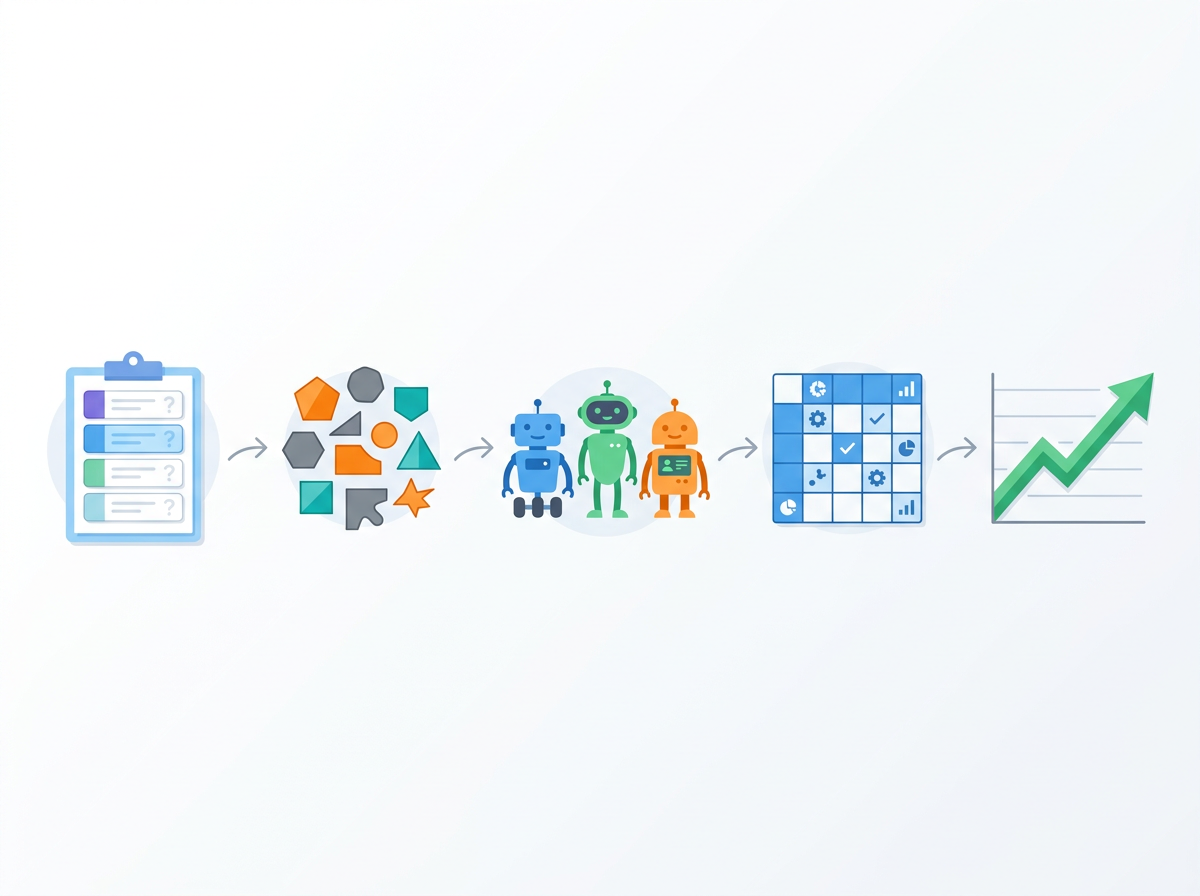
The process is the same whichever tool you use.
1. Build a prompt set from buyer questions
Write the questions your customers ask when comparing options: category questions ("best X for Y"), comparison questions, and problem questions. A few dozen well-chosen prompts beat hundreds of vague ones. Citeflare counts one tracked question as one prompt, scanned daily on every enabled engine.
2. Define your competitors
List the brands that actually appear next to you in answers, not only the ones you think you compete with. AI assistants often name different rivals than Google does, since Google rankings do not predict AI mentions.
3. Run every engine, not one
Compare ChatGPT, Gemini and Claude side by side. Engines draw on different sources and phrase recommendations differently, so a brand can lead on one and be absent on another.
4. Read the brands x engines view
A matrix of brands against engines shows where you are strong, where a rival dominates, and where nobody is named yet. The empty cells are often the easiest wins.
5. Watch the trend, not the day
Because answers vary, judge movement across weeks. Our piece on whether AI answer tracking scores are accurate explains variance in detail.
What do the top-ranking pages miss?
Vendor feature pages and roundups usually explain the concept and list tools. They tend to leave out four things buyers need.
- How the number is calculated. Ask any vendor for the exact formula and the window. Without it you cannot compare tools.
- Variance. Answers change between runs. A tool that presents one daily percentage as fact is overstating its certainty.
- Causes. Share of voice is an outcome. The causes are the sources AI cites, such as publisher domains, Reddit threads and YouTube videos. See citation analysis and how AI assistants choose brands.
- What happens next. Monitoring-only tools leave the fix to you.
How do the main approaches compare?

| Approach | What you get | Limits |
|---|---|---|
| Manual checking in each assistant | Free, quick sense of the answers | Not repeatable, no trend, no share calculation |
| Monitoring-only tools | Mentions and share of voice dashboards | Often stop at reporting; you plan the fix elsewhere |
| SEO suites adding an AI module | Familiar interface, one login | AI coverage can be narrower than a dedicated tool |
| Tracking plus citations plus content (Citeflare) | Share of voice, sources, crawler logs and drafting in one workspace | Broader than you need if you only want a read-only report |
Other tools assistants often name for this question include Profound, Peec AI, Otterly.AI, AthenaHQ, Scrunch AI and Semrush. Compare them on the checklist above rather than on brand name. If you are weighing one specifically, see Scrunch AI alternatives.
How does Citeflare track AI share of voice?
Citeflare asks each engine your prompts through its API and stores the answer. Prompt tracking runs daily on every enabled engine, recording whether you were named, where you ranked and how that changes. Tracked engines include ChatGPT, Claude, Gemini, Perplexity, Grok, DeepSeek, Mistral, Llama, Google AI Overviews and Google AI Mode.
Competitor tracking then gives share of voice against the brands you list, in a brands x engines view. Visibility can also be compared by country, and each project has its own brand, competitors, country and language.
From there, scans become ranked tasks with critical gaps first. Content agents can draft articles from those gaps and brand facts, and publish to WordPress or any webhook after your review. The Citeflare agent answers plain-language questions from your own data, with ready-made playbooks such as competitor gaps and drop diagnoses. Crawler analytics shows whether bots like GPTBot, ClaudeBot and PerplexityBot are reaching your pages.
What does it cost?
Every plan starts with a 7-day free trial, no card required, and annual billing saves 20%. See pricing for full details.
- Starter, $39/month: 1 project, 50 tracked prompts, 3 engines, 5 articles a month.
- Growth, $119/month: 3 projects, 250 tracked prompts, all 10 engines, 30 articles a month, crawler analytics, publishing and autopilot.
- Agency, $319/month: 10 projects, 1,000 tracked prompts, all 10 engines, 100 articles a month, priority support.
Competitor share of voice is included on all three. Starter tracks three engines of your choice, enough to cover ChatGPT, Gemini and Claude. For budgeting guidance, read about AI visibility tracking cost for small B2B SaaS teams. Agencies running several clients can look at AI search visibility for agencies.
What should you do once you know your share?
First, find the prompts where a rival is named and you are not. Second, check which sources the answers cite for those prompts. Third, create or improve content that fills the gap, following how to structure content so AI assistants cite it. Then keep watching the trend to see whether the share moves. For the broader discipline, see the guide to generative engine optimization.
FAQ
What is the best tool to track AI share of voice across ChatGPT, Gemini and Claude?
The best one runs real prompts daily on all three engines, lets you choose competitors, shows a brands x engines view and explains the sources behind answers. Citeflare does this and adds task lists and content drafting. Compare any shortlist against the checklist above.
How is AI share of voice calculated?
In Citeflare, it is your mentions divided by all mentions of you and your tracked competitors in the selected window. Always ask other vendors for their formula.
Are the numbers real answers?
Yes. Citeflare asks each engine your prompts through its API and stores the answer. Answers vary between runs, so treat scores as a trend line rather than a guarantee.
How often should share of voice be measured?
Daily scans with weekly review work well, because single-day readings fluctuate. Judge direction over several weeks.
Can I track more than one brand or country?
Yes. Each project has its own brand, competitors, country and language. Growth includes 3 projects and Agency includes 10.
Can I try it before paying?
Yes. Every plan has a 7-day free trial with no card required, and the first scan runs the day you sign up.